Planning a high-end outdoor event along the Atlantic coastline requires more than an eye for aesthetics and floral arrangements. In the Hamptons, the dramatic ocean views come with unique meteorological challenges that can jeopardize the safety and success of any gathering.
In this blog, we will examine the technical requirements of coastal event engineering and why proper anchoring is the foundation of luxury tenting. Long Island Tent & Party Rental specializes in navigating the complex wind patterns and soil conditions found throughout Suffolk County, from the dunes of Montauk to the expansive estates of Southampton. Understanding the physics of wind-stability is essential for hosts who want to ensure their celebration remains undisturbed by the unpredictable coastal elements.
The Physics of Coastal Tenting: Why Engineering Matters
When a tent is erected on a beachfront property in the Hamptons, it essentially becomes a massive sail designed to capture moving air. The physics of coastal tenting revolve around managing wind load and uplift, two forces that can quickly compromise a structure if not properly calculated. Coastal winds are rarely constant: they are characterized by sudden gusts and direction shifts as the air moves across the water and meets the land. When wind hits a tent, it creates high pressure on the windward side and low pressure on the leeward side, effectively trying to lift the entire structure off the ground. In engineering terms, this is known as aerodynamic lift. Without a rigid frame or a meticulously tensioned fabric system, the tent fabric can begin to flutter or “billow,” which puts immense stress on the poles and joints. Professional event engineering involves calculating a structure’s exact wind rating to ensure it can withstand the specific Beaufort scale readings common along the Long Island coastline.
To maintain structural integrity during an oceanfront event, several engineering factors must be meticulously balanced:
- Wind Load Distribution: The ability of the tent frame or poles to transfer the force of the wind down into the anchoring system without bending or snapping.
- Uplift Resistance: The total downward force required to counteract the vacuum effect created when wind passes over the top of the tent.
- Tension Management: Maintaining the perfect level of tightness in the fabric to prevent water pooling and to minimize the surface area vulnerable to wind vibration.
- Lateral Stability: Reinforcing the structure against side-to-side movement, which is often achieved through cross-bracing or heavy-duty guy lines.
- Component Strength: Utilizing high-grade aluminum or steel fittings that can withstand the corrosive salt air of the Hamptons without sacrificing structural load capacity.
Advanced Anchoring Techniques for Sandy and Unstable Soil
Securing a massive structure on the soft, shifting sands of a Montauk dune or a Southampton beach requires a total departure from standard inland anchoring methods. In typical soil, friction provides the necessary holding power for stakes, but sand lacks the cohesive properties required to grip traditional hardware during high-wind events. To solve this, coastal event engineers employ advanced anchoring techniques that rely on either deep-penetration mechanics or significant ballast weight. Hurricane stakes, which are longer and often feature specialized fluting or corkscrew patterns, are driven deep into the subsoil to reach more stable ground beneath the surface layers. When the terrain consists of luxury decking, stone patios, or sensitive manicured lawns where driving stakes is prohibited, the engineering team must transition to integrated ballast systems. These systems use heavy concrete blocks, often called G-blocks, to provide the immense downward force needed to keep the tent stationary against landward gusts.
Proper anchoring in the unstable terrain found throughout the Hamptons involves several specialized approaches:
- Double-Staking and Gang-Staking: This technique involves driving multiple stakes at opposing angles to create a mechanical lock within the sand, significantly increasing pull-out resistance.
- Deadman Anchors: For extreme coastal conditions, engineers may bury a heavy object or a structural beam deep beneath the sand to serve as a permanent, fixed point for high-tension cables.
- G-Block Ballast Systems: These utilize precast, engineered concrete weights that are precisely calculated to match the structure’s specific surface area and anticipated wind load.
- Earth Anchors: These screw-in anchors provide superior grip in sandy environments by using a helical blade to “bite” into the soil rather than relying on simple friction.
- Sub-Surface Base Plates: Adding specialized wide plates at the base of tent poles helps distribute vertical load, preventing the structure from sinking into soft terrain during heavy rain.
Frame Tents vs. Sailcloth: Selecting the Right Structure for the Shore
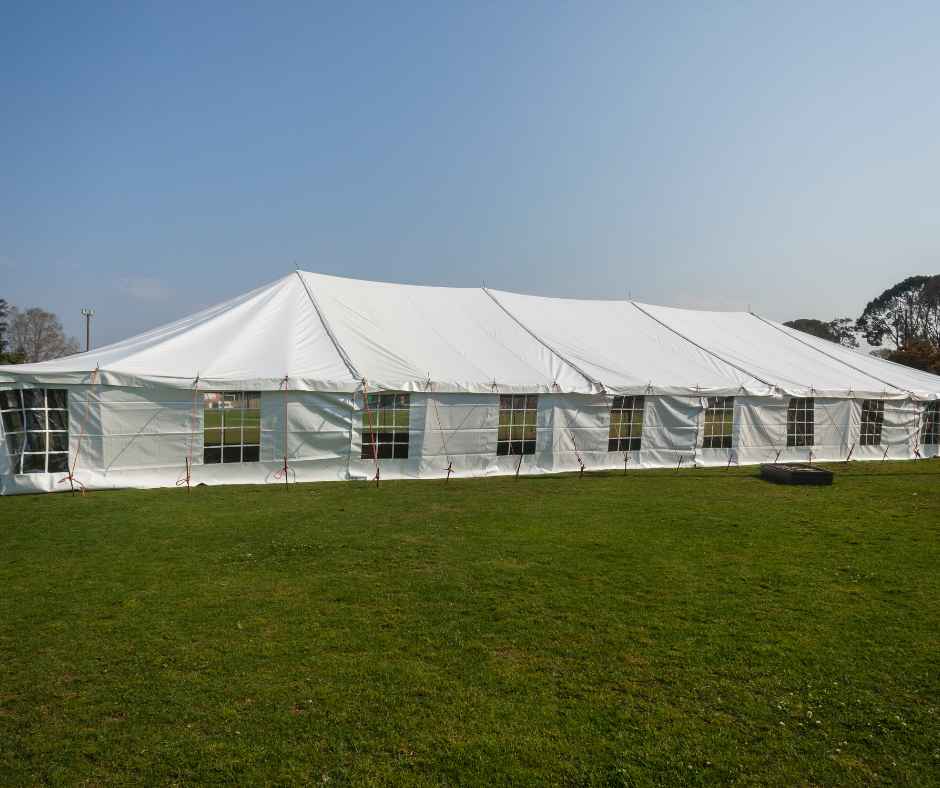
Choosing the appropriate architectural style for a coastal event is a decision that balances aesthetic vision with structural necessity. In the Hamptons, the two most popular options are Clear Span frame tents and Sailcloth pole tents, each offering distinct engineering advantages for waterfront environments. Clear Span structures are the heavy-duty workhorses of the industry. They feature a rigid aluminum box beam frame that supports the fabric without the need for interior poles. This design offers exceptional lateral stability and is often rated for much higher wind speeds than traditional designs. Conversely, Sailcloth tents are prized for their elegant, translucent fabric and towering wooden poles that mimic the nautical spirit of the Long Island shore. While they are stunning, they rely entirely on high-tension lines for stability. If the tension in a Sailcloth tent is not perfectly balanced by an expert engineering team, the structure becomes much more susceptible to the swaying forces of the Atlantic breeze.
When selecting a structure for a coastal property, event planners should consider the following engineering differences:
- Wind Speed Ratings: Clear Span structures can often be engineered to withstand sustained winds of up to 60 or 70 miles per hour, whereas Sailcloth tents typically have lower thresholds.
- Interior Obstructions: Frame tents offer a fully open floor plan, providing unobstructed ocean views and more flexible seating for large weddings.
- Footprint Requirements: Sailcloth tents require a larger “setback” for their guy lines and anchors, which can be a limiting factor on narrow beach lots or cliffside properties.
- Foundation Compatibility: Frame tents can be easily leveled using integrated flooring systems on uneven dunes, while pole tents require a relatively flat surface for proper tensioning.
- Aesthetic Flexibility: Sailcloth tents offer a soft, romantic glow during evening events, whereas frame tents allow for modern “clear-top” designs that provide a panoramic view of the night sky.
Compliance and Safety Standards for Suffolk County Events
Navigating the regulatory landscape in the Hamptons is as critical as the tent’s physical assembly. Local municipalities across Suffolk County, including East Hampton and Southampton, enforce strict safety codes to protect guests from the hazards associated with temporary structures. These regulations are informed by the International Building Code and are specifically adapted to address the high-wind risks of the Long Island coastline. Every large-scale tent installation requires a thorough permitting process that includes submitting site plans and flame-retardant certificates for all fabrics. Furthermore, the local Fire Marshal often conducts on-site inspections to verify that the structure meets specific egress requirements and that all anchoring systems are installed in accordance with the manufacturer’s engineering specifications. Failure to comply with these standards does not just result in potential fines: it poses a genuine liability risk for the host and the event planner.
To ensure your event meets all legal and safety benchmarks in the Hamptons, our team manages several key compliance factors:
- Wind Speed Documentation: We provide engineering stamps and manufacturer data that certify the tent’s ability to withstand specific wind velocities as required by local code.
- Flame Resistance Certification: All tent materials are NFPA 701 compliant, ensuring they are treated to resist ignition and slow the spread of fire.
- Egress and Lighting Design: We design floor plans that provide clear, illuminated exit paths and maintain the required distance between the tent and existing structures.
- Load Calculation Reports: For events featuring heavy hanging decor or lighting rigs, we perform load calculations to ensure the frame or poles can safely support the additional weight.
- Emergency Weather Protocols: We establish “action stages” based on real-time weather monitoring, defining exactly when a tent should be evacuated or reinforced based on wind gusts.
Site Assessment: Predicting Microclimates in the Hamptons
One of the most overlooked aspects of coastal event engineering is the impact of local microclimates. A property located behind a dense tree line in Water Mill will experience vastly different wind pressures than a bluff-top estate in Montauk. Professional site assessment involves analyzing how the natural topography of the Hamptons interacts with the prevailing Atlantic winds. Elevation changes, such as the rolling hills of Bridgehampton, can create “wind tunnels” where air speeds accelerate as it is squeezed between topographic features. Similarly, the presence of a nearby tall structure can create turbulence, leading to erratic wind patterns that are more difficult to manage than a steady breeze. Our engineers visit the site weeks in advance to map these variables, ensuring the tent’s orientation and anchor placement are optimized for the specific environment.
During a comprehensive site assessment, we analyze several environmental variables to ensure structural stability:
- Topographical Wind Speed-Up: We identify ridges or escarpments that could accelerate wind as it climbs the terrain toward your event space.
- Ground Composition Analysis: We perform soil probe tests to determine whether we are working with compact earth, loose sand, or backfilled land.
- Natural Windbreaks: We evaluate the health and density of existing tree lines or hedgerows to determine whether they will provide shelter or pose a hazard from falling debris.
- Shoreline Erosion Vulnerability: For beachfront installs, we assess the stability of the dunes and the potential for high-tide encroachment during a storm surge.
- Hydrological Drainage Patterns: We map the land’s slope to ensure that heavy spring or summer rains drain away from the tent’s anchoring points.
Elevating Your Event with Technical Precision
Success for a high-profile event in the Hamptons is measured by the seamless integration of luxury and safety. When the sun sets over the Atlantic and the evening breeze picks up, your guests should feel nothing but the comfort of a well-executed celebration. Achieving this requires a deep commitment to the technical side of event production, from the physics of wind-stability to the precision of advanced anchoring. By choosing a partner that prioritizes coastal engineering, you eliminate the stress of the unknown and ensure that your aesthetic vision is supported by an unbreakable foundation. At Long Island Tent & Party Rental, we believe that the most beautiful events are those where the engineering is so perfect that it remains completely invisible to the guests.
Long Island Tent & Party Rental is ready to bring this level of expertise and structural integrity to your next coastal gathering. For a consultation regarding your waterfront property and to ensure your celebration is anchored with precision, contact us today and begin your event engineering journey.
Frequently Asked Questions
How do you protect a tent if a sudden hurricane-strength gust occurs during an event?
Our systems are monitored with on-site anemometers. If gusts exceed the structure’s safety rating, we follow a pre-established evacuation plan that includes dropping side curtains to reduce wind “catch” and clearing the area for guest safety.
Can you install a tent on a cliffside property with significant elevation changes?
Yes. We use laser-leveling technology and modular flooring systems to create a perfectly flat foundation, ensuring the tent’s uprights remain vertical and the load is evenly distributed across the slope.
Does salt air affect the tension of the tent fabric over a multi-day event?
Salt and moisture can cause certain fabrics to expand slightly. Our crew performs “tension checks” every 24 hours for long-term installs to ensure the canopy remains taut and wind-resistant.
Are there “noise-dampening” engineering options for windy nights?
To prevent the “flapping” sound of fabric, we use high-tension ratchets and specialized keder tracks that lock the tent walls into the frame, creating a quieter and more solid interior environment.
What is the difference between a “ballasted” tent and a “staked” tent in terms of wind rating?
While both can be safe, a staked tent generally offers greater resistance because it is physically anchored to the ground. However, a properly engineered ballast system using concrete weights can achieve similar safety ratings for hard-surface installs.